Why Your Google Business Profile Matters More Than Your Website for Local Search
By Brainted · May 5, 2026
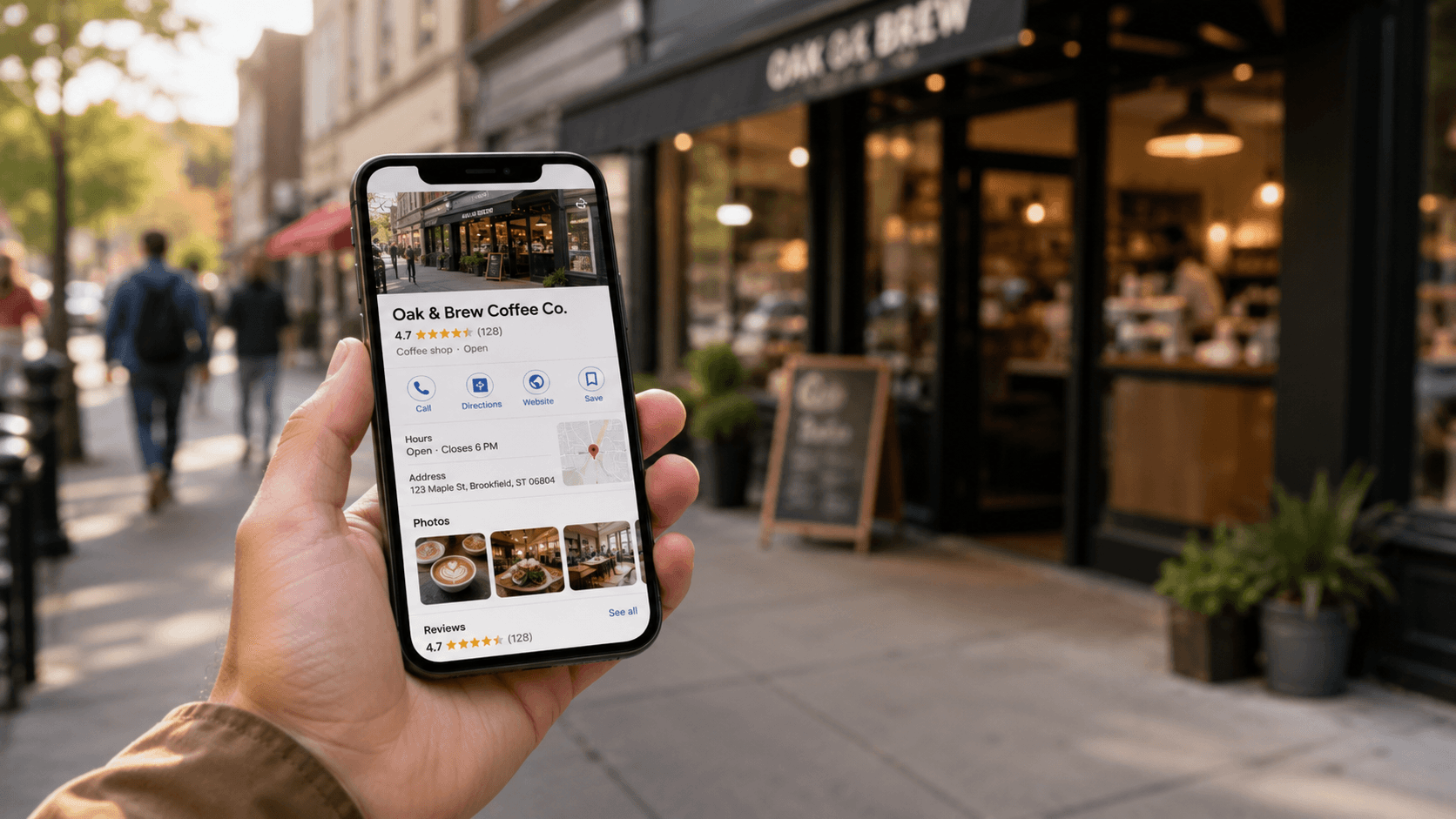
For many local businesses, the first meaningful interaction with a potential customer does not happen on the company website.
It happens directly in Google Search or Google Maps.
Someone searches for “café near me,” “personal trainer in Stuttgart,” or “electrician nearby,” and Google immediately presents a selection of local businesses.
Before visiting a website, the customer may already see:
- Opening hours
- Customer reviews
- Photos
- The business location
- Contact details
- Services
- Directions
- A call button
In many cases, the customer makes a decision without opening the website at all.
That is why a well-maintained Google Business Profile can be one of the most important digital assets for a local business.
Your Profile Is Often the First Impression
When customers search for a local service, they are usually looking for a fast and practical answer.
They want to know:
- Is the business nearby?
- Is it currently open?
- Does it have good reviews?
- Does it look professional?
- Can I call or visit immediately?
- Does it offer what I need?
Your Google Business Profile answers many of these questions before the visitor reaches your website.
If the information is incomplete, inaccurate, or outdated, the customer may move directly to a competitor.
A strong profile, on the other hand, can create trust within seconds.
Local Searches Often End on Google
Traditional websites are designed to encourage visitors to browse pages and learn more about a company.
Local search often works differently.
A customer may search for a business, compare a few map results, read reviews, check the opening hours, and then call or request directions.
The entire customer journey can happen inside Google.
This means your profile is not only a link to your website. It is a conversion tool in its own right.
For some businesses, actions such as phone calls, direction requests, and bookings from the profile may be more valuable than website visits.
Accurate Business Information Is Essential
Incorrect information can quickly lead to lost customers.
Imagine someone drives to your location because Google says you are open, only to find the doors closed.
That customer may not return.
Important information should always be kept up to date, including:
- Regular opening hours
- Holiday and special opening hours
- Phone number
- Address
- Website link
- Services
- Business description
- Appointment or booking links
Holiday hours are especially important because customers often rely on Google during public holidays and special events.
A small update can prevent frustration and protect the reputation of your business.
Choose the Right Business Category
Your primary business category helps Google understand what your company offers.
This can influence which searches your business appears in.
A broad or inaccurate category may reduce your visibility for relevant local searches.
For example, a business should not simply choose “Fitness Centre” if “Personal Trainer,” “Boxing Gym,” or “Pilates Studio” describes the service more accurately.
Choose the category that best represents the main service your business provides.
Additional categories can be added when they genuinely reflect other important services.
Avoid selecting unrelated categories purely to appear in more searches. Accuracy is more valuable than quantity.
Use Real, High-Quality Photos
Photos help potential customers understand what to expect before they visit.
For restaurants, cafés, gyms, salons, shops, and clinics, this can strongly influence the final decision.
Useful photos may include:
- The exterior of the business
- The entrance
- The interior
- The team
- Products
- Completed work
- Equipment
- Customer areas
- The atmosphere of the location
Real photographs are usually more convincing than generic stock images.
Customers want to see the actual business they may visit.
The photos do not need to look like a luxury advertising campaign, but they should be bright, clear, current, and professional.
Reviews Build Trust Before the Website Does
Customer reviews are one of the most visible parts of a Google Business Profile.
A business with many recent and detailed reviews often appears more trustworthy than one with only a few old ratings.
Reviews help customers understand:
- The quality of the service
- How the staff treat customers
- Whether the business is reliable
- What the atmosphere is like
- How the company handles problems
A strong review profile can make a customer choose your business before they ever visit your website.
Encourage satisfied customers to leave honest feedback, but do not pressure them or offer misleading incentives.
The goal is to build a natural and credible review history over time.
Reply to Every Review
Responding to reviews shows that the business is active and values customer feedback.
Positive reviews deserve a genuine thank-you.
Negative reviews should be handled calmly, professionally, and without becoming defensive.
A useful response to a negative review should:
- Acknowledge the customer’s experience
- Remain respectful
- Avoid public arguments
- Offer a practical next step
- Move detailed discussions to a private channel
Your reply is not only written for the original reviewer.
Future customers will also read it and judge how your business handles criticism.
A professional response can sometimes create more trust than a perfect rating with no engagement.
Keep the Profile Active
An abandoned profile can make a business appear inactive.
Regular updates show both customers and Google that the information is current.
You can keep the profile active by:
- Uploading new photos
- Updating opening hours
- Adding services
- Publishing offers or announcements
- Answering customer questions
- Responding to reviews
- Checking that contact details remain correct
You do not need to update the profile every day.
Consistency is more important than frequency.
A short monthly check is often enough to prevent outdated information from remaining visible for too long.
Your Website Still Matters
A strong Google Business Profile does not make your website unnecessary.
The two serve different purposes.
Your profile helps customers discover and evaluate your business quickly.
Your website gives them more space to confirm the decision.
Customers may visit your website to:
- Understand your services in detail
- Compare packages or prices
- View projects or case studies
- Learn more about the team
- Read frequently asked questions
- Book an appointment
- Send a detailed enquiry
- Confirm that the business feels professional
The profile brings your business into consideration.
The website gives customers the confidence to move forward.
The Best Results Come From Both
Local visibility works best when your Google Business Profile and website support each other.
The information on both should be consistent.
This includes:
- Business name
- Address
- Phone number
- Opening hours
- Services
- Branding
- Website links
If Google sees consistent information across your website and other trusted platforms, it becomes easier to understand the business and its location.
Your website can also support local search by including:
- Clear location information
- Dedicated service pages
- Local keywords used naturally
- Customer reviews
- Structured business data
- Fast mobile performance
- Accurate contact details
The goal is not to choose between a profile and a website.
The goal is to use both effectively.
Start With the Profile Customers Already See
If your Google Business Profile is incomplete or outdated, improving it should be a priority.
Start with the basics:
- Confirm your opening hours
- Check your contact details
- Select the correct category
- Upload recent photos
- Reply to unanswered reviews
- Add your most important services
- Confirm that your website link works
These improvements are relatively simple, but they can have a direct impact on how customers discover and evaluate your business.
A polished website remains an important part of your online presence.
But for local businesses, the Google Business Profile is often what gets you noticed first.
It creates the initial impression, builds early trust, and helps customers decide whether your business deserves the next click, call, or visit.